EV MASTER SET — VOL 01 + VOL 0266 chapters · 172 pages150+ fault recipesFree delivery all over IndiaSoft copy free with hard copy2W · 3W · 4W · AIS & IS referenced
M MASTERYBOOKS
FIELD MASTER SERIES · VOLUME ONE + VOLUME TWO

EV Engineering · Diagnostics · Repair Stop guessing.
Start measuring.

The two-volume EV technician's handbook — 66 chapters, 172 pages. Volume One builds the system understanding. Volume Two takes you to the bench with 150+ fault recipes, expected-value tables and waveform references.

66Chapters
150+Fault recipes
09Workbench refs
2W·3W·4WScope
HV — treat as live Cell → Module → Pack

Cell testing, matching, rebuilding, BMS relearn — all of it, at bench level.

BOTH VOLUMES IN ONE SET
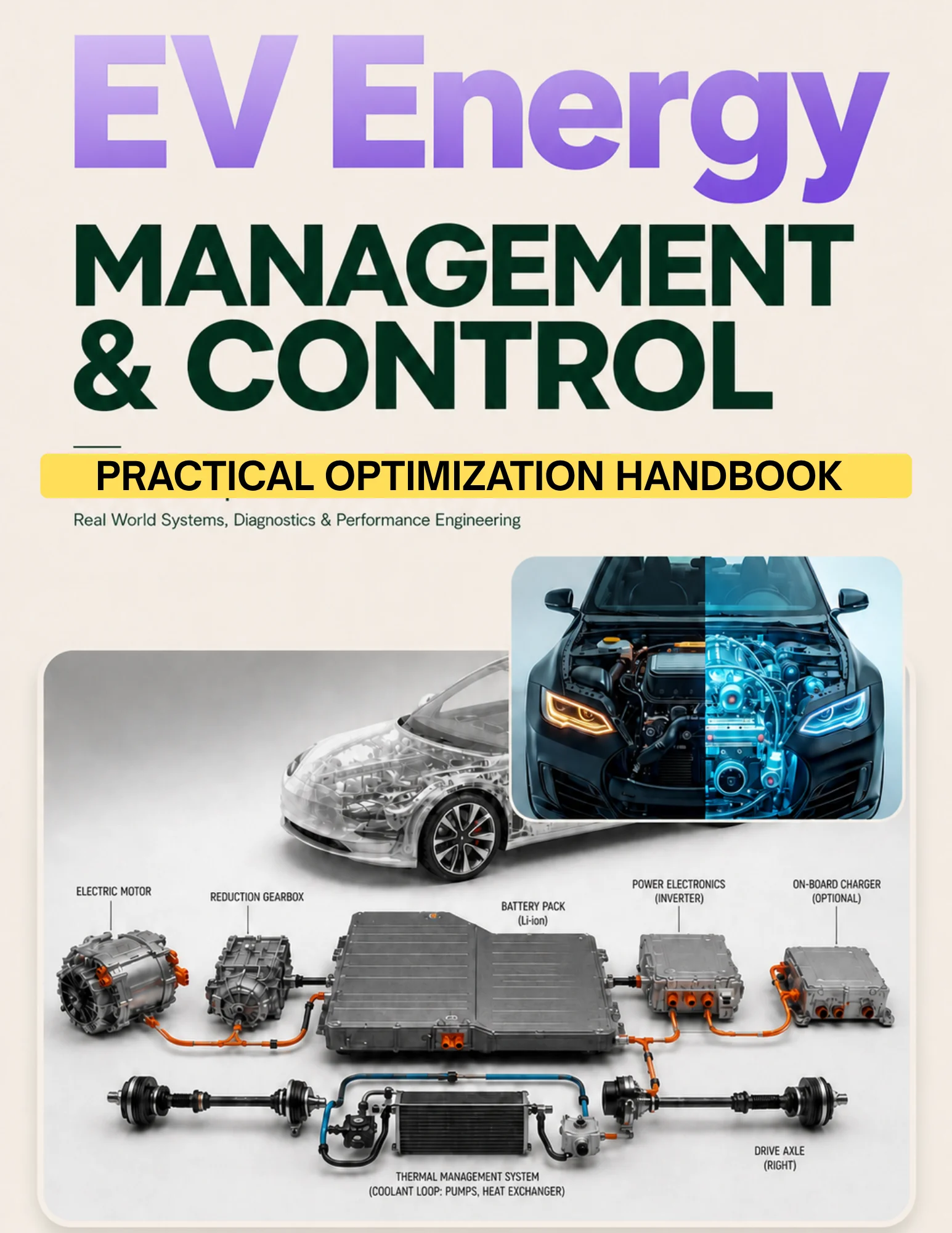
EV Energy Management and Control handbook
VOL 01 · Energy Management
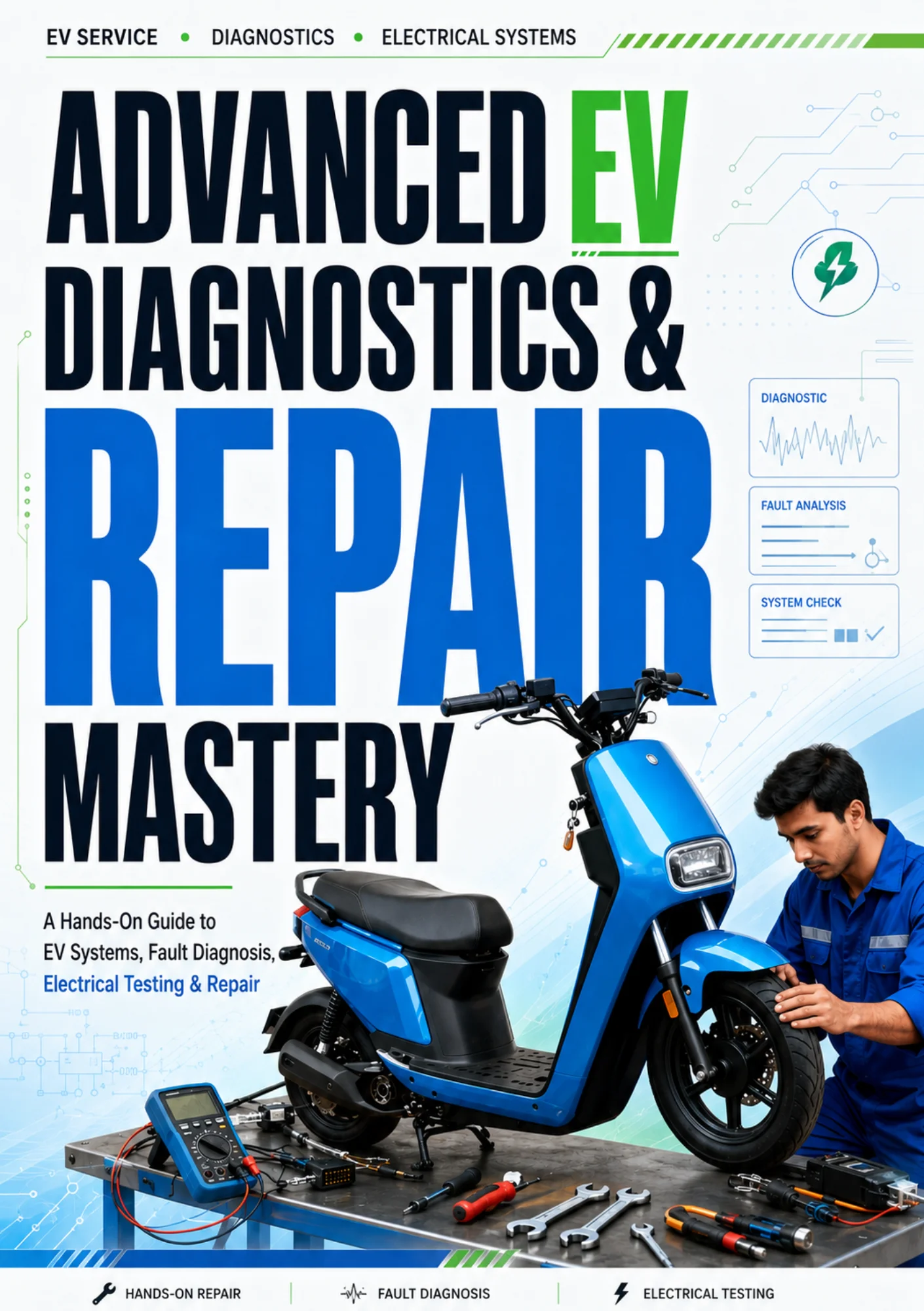
Advanced EV Diagnostics and Repair Master Handbook
VOL 02 · Diagnostics & Repair
Built for Indian 2W, 3W & 4W workshops AIS-038 Rev.2, AIS-156, IS 17017 referenced Expected-value tables on every measurement A5 bench handbook — opens flat on the table Nothing repeated between the two volumes

Six jobs where parts get replaced without a diagnosis

Every one of these has a chapter written around it — not a definition, a procedure.

RANGE

Range drops but the pack "reads fine" — voltage looks equal, so the weak cell keeps hiding. Vol 01 Ch. 9 · Vol 02 Ch. 17 — Capacity, internal resistance & cell matching

HVIL

Vehicle refuses to close the contactors and the interlock loop has twelve places to break. Vol 02 Ch. 11 & 13 — HVIL tracing, contactors & pre-charge

CAN

Multiple unrelated errors appear at once — because the bus is the fault, not the modules. Vol 01 Ch. 16 · Vol 02 Ch. 7–9 — Bit timing, bus load, DBC & UDS

MOTOR

Hub motor jerks or refuses to spin, and phase–Hall combinations get swapped by trial and error. Vol 02 Ch. 26–28 — Back-EMF, Hall logic, hub motor repair

CHARGE

Charging stops midway and nobody can say whether it is the vehicle, the charger or the supply. Vol 01 Ch. 20 · Vol 02 Ch. 33 — Handshake decoding, Type-2, CCS2, GB/T

CLAIM

A repaired pack comes back, and there is no job card to prove what was measured before handover. Vol 02 Ch. 39–40 — Job card, SOP, pricing, warranty & liability

Most EV repair loss is not a technical loss. It is a diagnosis loss — a good component replaced because nobody measured, and a bad one shipped because nobody recorded. These two volumes exist to close that gap: a value to expect, a way to measure it, and a decision to take.

Volume One · The Core

Power flows both ways — that is the whole EV

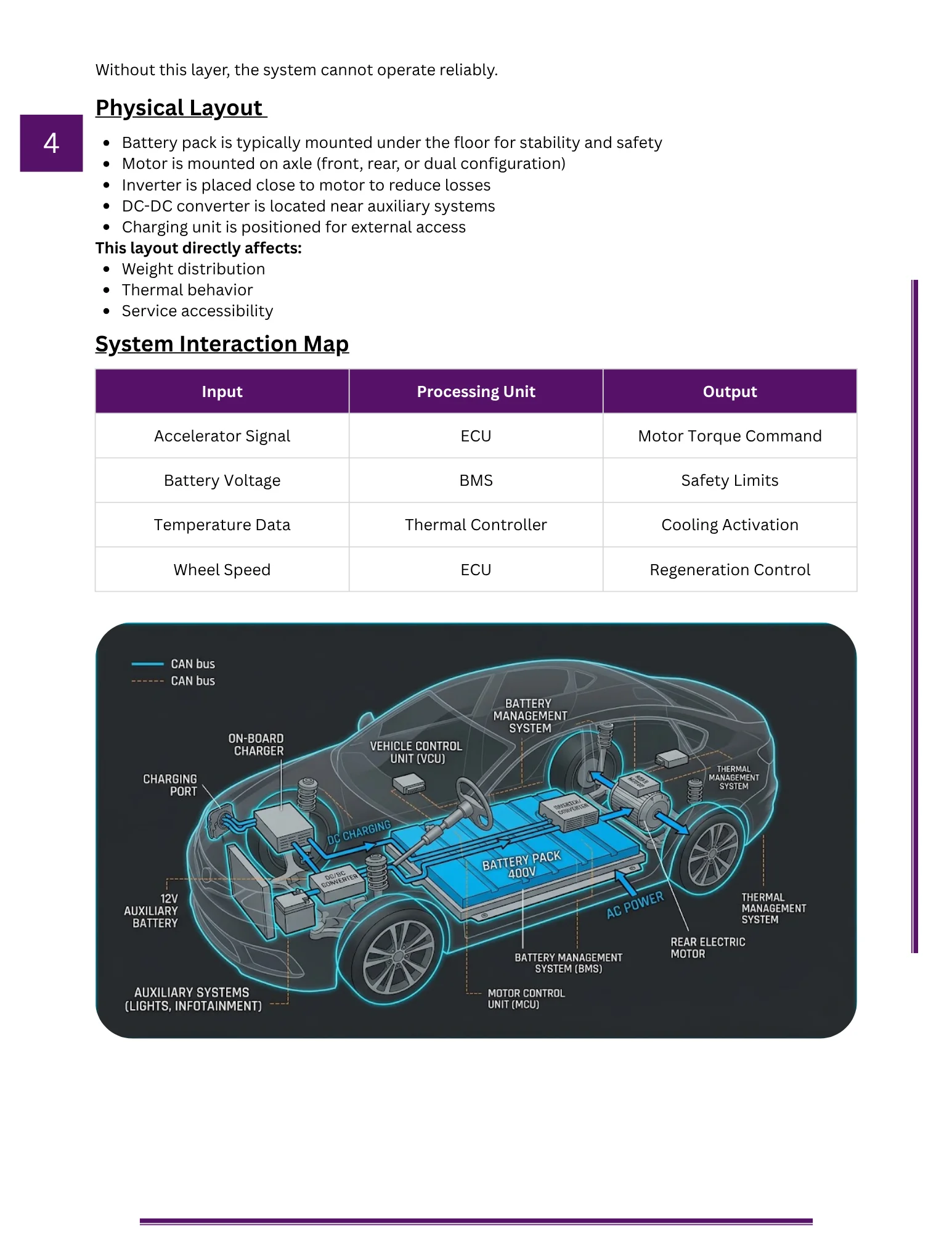
An EV is not a fuel system with a battery bolted on. Energy moves forward under drive and backward under regeneration, and every fault you will ever chase sits somewhere on this path.

DC
Battery PackCells, BMS, thermal — stores and limits
INV
InverterDC to AC, frequency sets the speed
M
MotorBLDC, PMSM or induction — torque out
WH
WheelsWhere the driver judges your work

Because the path is bidirectional, a "braking complaint" can be a battery complaint — Volume One teaches you to read it that way.

Volume Two · The Method

Symptom → System → Signal → Component

The habit that separates a technician from a parts-changer. You never jump from the complaint straight to a component — you narrow it, one verified step at a time.

Step 01 · SymptomWhat the vehicle actually does Not what the customer thinks is wrong. Conditions, repeatability, when it appears.
Step 02 · SystemWhich system owns that behaviour Battery, drive, charging or network — narrow it before touching anything.
Step 03 · SignalMeasure and compare to the expected value Voltage, waveform, resistance, bus traffic — a reading only means something against a limit.
Step 04 · ComponentOnly now, replace or repair And you can explain to anyone why it was that part and no other.
CAN H / CAN L · 500 kbit/s2 V / div
CAN H — recessive 2.5 V, dominant 3.5 VCAN L — dominant 1.5 V

One volume builds the understanding. The other puts it on the bench.

Volume Two assumes Volume One and never repeats it — where a topic belongs to Volume One, Volume Two goes deeper instead of rewriting it. Together: 66 separate chapters.

Volume One · Foundation

EV Energy Management & Control

Architecture, high-voltage safety, storage, BMS, drivetrain, networks, charging and thermal.

26Chapters
08Sections
68Pages
  • 01Foundations — EV vs ICE, architecture & power flow, applied electrical basics
  • 02Safety & high voltage — protocols, PPE, isolation & emergency handling
  • 03Energy storage — Li-ion, LFP, solid-state, pack design, thermal behaviour
  • 04Battery management — BMS architecture, fault detection, pack diagnostics
  • 05Drivetrain — BLDC, PMSM, induction, controllers, inverters, torque control
  • 06Communication & control — CAN bus, scanners, sensors & ECU integration
  • 07Charging & energy — AC/DC/fast charging, fault diagnosis, regen, thermal
  • 08Real-world skills — step-by-step fault diagnosis, case studies, workshop setup
Volume Two · Bench level

Advanced EV Diagnostics & Repair

Where the multimeter stops — waveforms, protocols, pack rebuilding, board repair, workshop system.

40Chapters
09Appendices
104Pages
  • 01–02The SSSC method, measurement discipline, the advanced bench, waveform libraries
  • 03Networks at protocol level — bit timing, DBC building, UDS, smart-BMS protocols
  • 04HV fault engineering — HVIL, insulation & IMD, contactors, pre-charge, DC-DC
  • 05Pack repair & rebuild — teardown, cell matching, spot welding, re-celling
  • 06BMS deep engineering — SOC/SOH drift, protection windows, relearn, balancers
  • 07Motor & controller — back-EMF, Hall logic, hub repair, board-level controller repair
  • 08Charging equipment — OBC board repair, Type-2 / CCS2 / GB/T, EVSE & RCD Type-B
  • 09–10Thermal runaway forensics, Indian compliance, workshop design, job cards, pricing
  • A–IReference appendices — checkpoint charts, fault recipes, DTC lookup, value cards
Full contents

Open all 66 chapters before you decide

Nothing hidden. Both volumes, section by section.

VOL 01 Foundations, safety & energy storage Ch. 1–9
  • EV vs internal combustion engine — complete system comparison
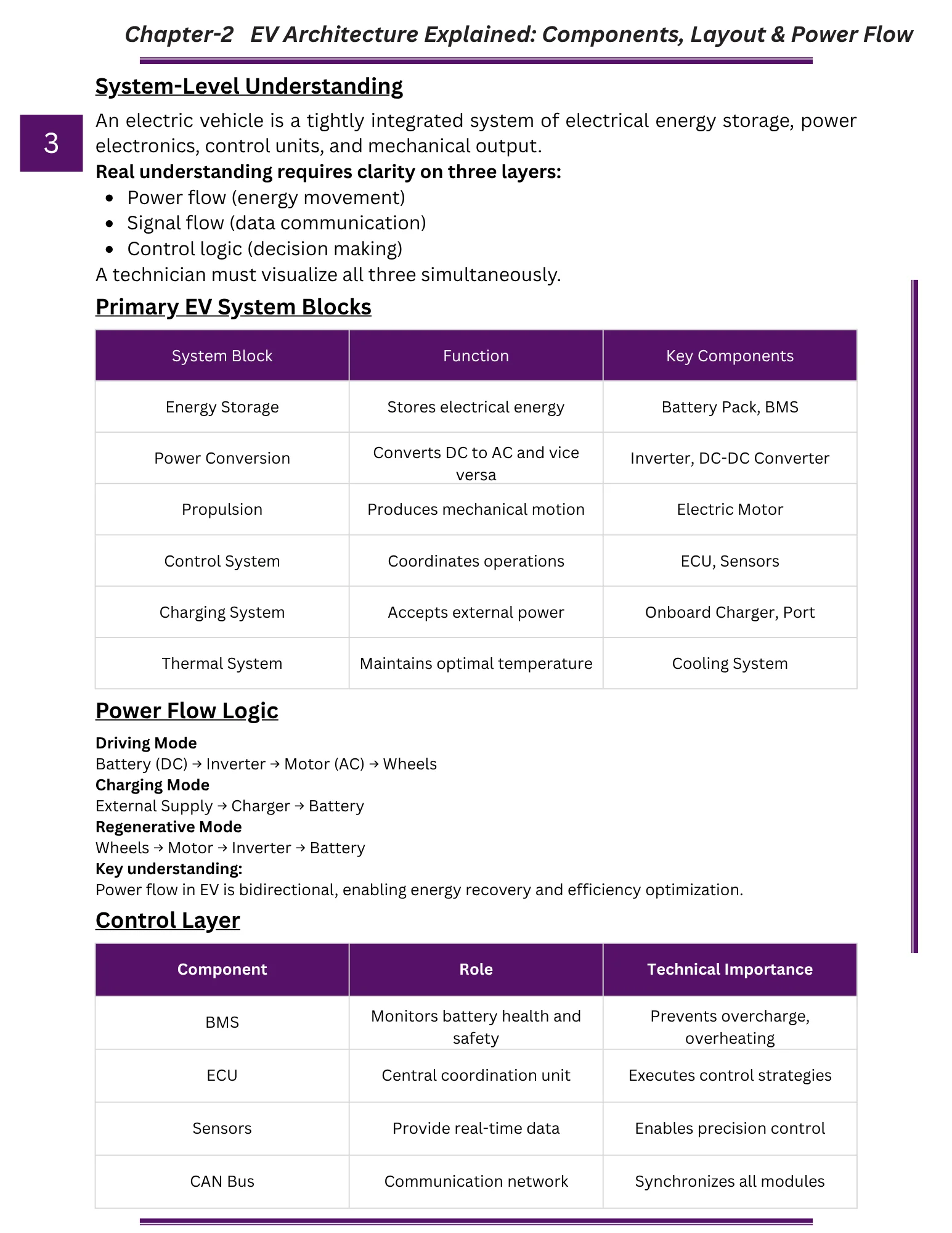
  • EV architecture explained — components, layout & power flow
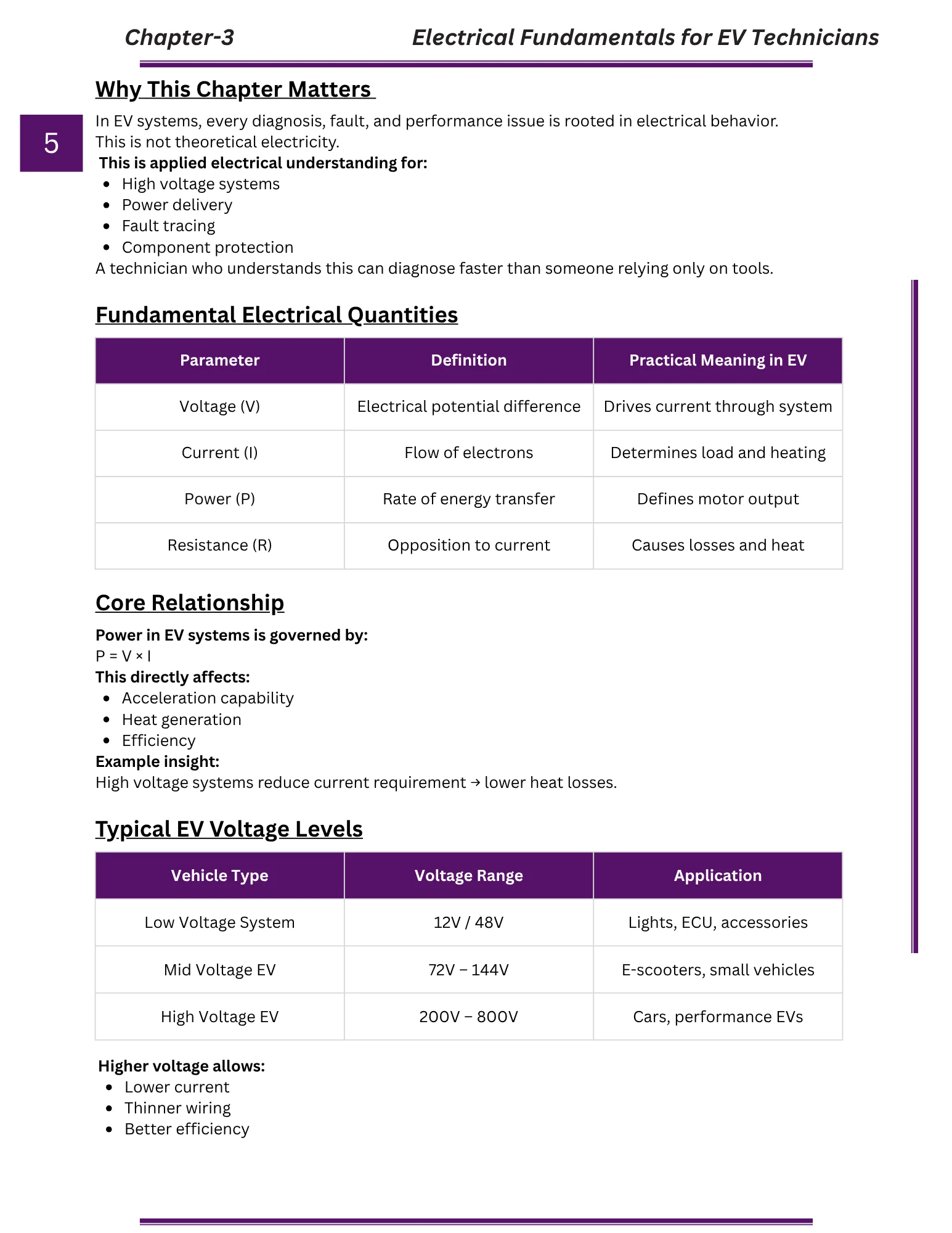
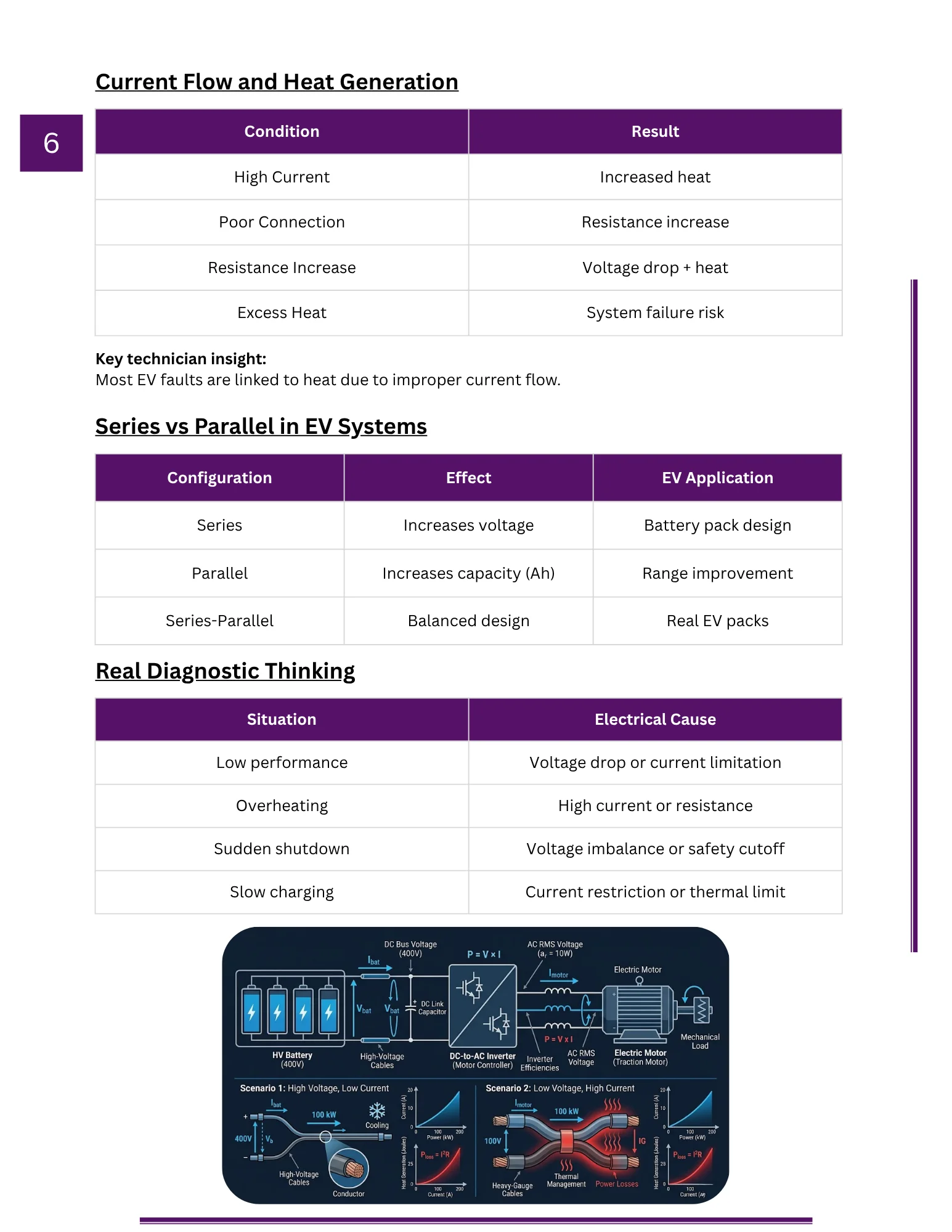
  • Electrical fundamentals for EV technicians — voltage, current, power
  • High voltage safety protocols & industry standards
  • PPE & safe workshop practices
  • Isolation procedures & emergency handling in EV systems
  • Advanced energy storage — Li-ion, LFP, solid-state overview
  • Battery pack design, structure & thermal behaviour
  • Cell balancing, degradation & lifecycle management
VOL 01 BMS, drivetrain & communication Ch. 10–18
  • Battery Management System — architecture & logic
  • Fault detection, error codes & real-time monitoring
  • Battery pack diagnostics & repair methodology
  • Electric motors deep dive — BLDC, PMSM & induction
  • Motor controllers, inverters & power electronics
  • Torque control, efficiency mapping & performance optimization
  • CAN bus communication & vehicle networking
  • Diagnostic tools, scanners & software analysis
  • Sensor systems & ECU integration in EVs
VOL 01 Charging, thermal & real-world skills Ch. 19–26
  • EV charging infrastructure — AC, DC & fast charging systems
  • Charging fault diagnosis & grid interaction basics
  • Regenerative braking systems & energy recovery
  • Thermal management systems — cooling & heating strategies
  • EV fault diagnosis — step-by-step practical approach
  • Common failure case studies & troubleshooting framework
  • EV maintenance, service schedules & workshop setup
  • Future of EV technology — AI, smart grids & next-gen mobility
VOL 02 Method, instruments & protocol-level networks Ch. 1–10
  • The SSSC method — symptom → system → signal → component
  • Measurement discipline & intermittent fault capture
  • Building the advanced EV bench
  • Waveform library I — CAN, termination & noise patterns
  • Waveform library II — Hall, resolver, PWM & throttle
  • Three-phase current analysis & phase imbalance
  • CAN beyond basics — bit timing, bus load & physical faults
  • Message decoding & DBC file building
  • UDS (ISO 14229) & OBD diagnostic services
  • Smart-BMS & controller protocols in Indian 2W/3W
VOL 02 High-voltage faults & pack rebuild Ch. 11–21
  • HVIL interlock loop — architecture & fault tracing
  • Insulation failure — IMD logic & leakage path hunting
  • Contactors, pre-charge circuit & pyro fuse diagnosis
  • Busbar & terminal faults — the voltage-drop method
  • DC-DC converter failure & 12V phantom faults
  • Pack teardown protocol & damage classification
  • Cell testing — capacity, internal resistance & matching
  • Pack sizing maths — configuration, C-rate & range
  • Interconnect engineering — busbar, nickel strip & fusing
  • Spot welding — parameters, pull test & joint failures
  • Module replacement, re-celling & reassembly validation
VOL 02 BMS engineering, motor & controller repair Ch. 22–31
  • SOC & SOH estimation, drift correction, range prediction
  • BMS parameter configuration & protection windows
  • Calibration & relearn after pack repair
  • Active vs passive balancer — selection & installation
  • Motor health testing — resistance, insulation & back-EMF
  • Hall sensor diagnosis & phase–Hall combination logic
  • Hub motor repair — bearings, magnets, ingress & rewinding
  • Controller board anatomy — power stage & gate drive
  • Component-level controller repair & bench validation
  • Controller programming — square wave, sine wave & FOC
VOL 02 Charging equipment, compliance & workshop business Ch. 32–40
  • Onboard charger architecture & board-level repair
  • Handshake decoding — Type-2, CCS2 & GB/T failures
  • EVSE commissioning, earthing & RCD Type-B validation
  • Thermal runaway forensics — reading a burnt pack backwards
  • Damaged battery handling, quarantine & transport
  • AIS-038 Rev.2, AIS-156, IS 17017 & AIS-138 for workshops
  • Workshop design & tooling matrix — zones, tiers, cost bands
  • Job card, SOP & documentation system
  • Pricing, warranty, liability & claim engineering
VOL 02 Reference appendices — the workbench half A–I
  • A · Master multimeter checkpoint chart
  • B · Fault recipe directory
  • C · Error & DTC lookup directory
  • D · Hall sensor & phase wire combination table
  • E · Signal voltage cards
  • F · Component test value cards
  • G · Insulation & HV safety threshold chart
  • H · Sourcing & spares specification reference
  • I · Job card, inspection checklist & handover format

Most technicians read the chapters once and open the appendices every week.

Real pages

No mockups. This is what is inside.

Tables, system diagrams, measurement values and fault recipes — exactly as printed. Touch a page to pause.

Volume One · Energy Management & Control
Sample page
System comparison tables
Sample page
Architecture & power flow
Sample page
Safety zones & protocols
Sample page
Battery & BMS diagnostics
System comparison tables
Architecture & power flow
Safety zones & protocols
Battery & BMS diagnostics
System comparison tables
Architecture & power flow
Safety zones & protocols
Battery & BMS diagnostics
Volume Two · Advanced Diagnostics & Repair
Sample page
Bench procedure steps
Sample page
Expected-value tables
Sample page
Cell testing & matching rules
Sample page
Fault recipes & key insights
Bench procedure steps
Expected-value tables
Cell testing & matching rules
Fault recipes & key insights
Bench procedure steps
Expected-value tables
Cell testing & matching rules
Fault recipes & key insights

From technicians using it on live vehicles

EV service technicians, diagnostic engineers, battery technicians and workshop owners.

Yuvan Raghavan
Yuvan RaghavanEV Service Technician

EV diagnosis mein sabse kaam ki cheez iska structured approach hai. Symptom se seedha component par jump karne ke bajay pehle system aur signal verify karna — ye practically bahut farak laata hai. Battery, BMS, motor aur charging samajhne ke saath fault diagnosis ka poora flow bhi clear ho jaata hai.

Verified purchase
Ronav Bhonsle
Ronav BhonsleEV Diagnostic Engineer

Advanced handbook ka CAN, UDS, oscilloscope aur measurement wala section mere kaam ke liye sabse zyada useful raha. Signal ko expected value ke against compare karke decision lena — isse troubleshooting kaafi systematic ho jaati hai. Complex electrical faults ke liye solid workshop reference hai.

Verified purchase
Adit Varma
Adit VarmaEV Battery Technician

Battery pack repair ke liye isme kaafi practical information mili. Cell capacity, internal resistance, cell matching, pack rebuilding aur BMS calibration — sab aapas mein jude hue hain. Fault recipes aur component test values ki wajah se book ko bench par quick reference ki tarah bhi use kar leta hoon.

Verified purchase
Vedant Kamat
Vedant KamatEV Workshop Owner

Mere liye dono books ka combination sahi baithta hai — ek taraf EV architecture, high-voltage safety, charging aur basic diagnostics ka foundation, doosri taraf advanced repair aur workshop-level systems. Job card, SOP, tooling, documentation, pricing aur warranty wale topics workshop ke nazariye se kaafi kaam ke hain.

Verified purchase
Ritayan Sengupta
Ritayan SenguptaSenior EV Technician

Experience hone ke baad bhi intermittent electrical faults aur communication problems mein measurement discipline hi sabse zaroori hai. Is handbook mein CAN, HVIL, insulation faults, contactors, pre-charge, motor testing aur controller repair kaafi gehrai se cover kiye hain. Iska "reading → limit → decision" wala approach mujhe khaas practical laga.

Verified purchase
Yuvan RaghavanEV Service Technician

EV diagnosis mein sabse kaam ki cheez iska structured approach hai. Symptom se seedha component par jump karne ke bajay pehle system aur signal verify karna — ye practically bahut farak laata hai. Battery, BMS, motor aur charging samajhne ke saath fault diagnosis ka poora flow bhi clear ho jaata hai.

Verified purchase
Ronav BhonsleEV Diagnostic Engineer

Advanced handbook ka CAN, UDS, oscilloscope aur measurement wala section mere kaam ke liye sabse zyada useful raha. Signal ko expected value ke against compare karke decision lena — isse troubleshooting kaafi systematic ho jaati hai. Complex electrical faults ke liye solid workshop reference hai.

Verified purchase
Adit VarmaEV Battery Technician

Battery pack repair ke liye isme kaafi practical information mili. Cell capacity, internal resistance, cell matching, pack rebuilding aur BMS calibration — sab aapas mein jude hue hain. Fault recipes aur component test values ki wajah se book ko bench par quick reference ki tarah bhi use kar leta hoon.

Verified purchase
Vedant KamatEV Workshop Owner

Mere liye dono books ka combination sahi baithta hai — ek taraf EV architecture, high-voltage safety, charging aur basic diagnostics ka foundation, doosri taraf advanced repair aur workshop-level systems. Job card, SOP, tooling, documentation, pricing aur warranty wale topics workshop ke nazariye se kaafi kaam ke hain.

Verified purchase
Ritayan SenguptaSenior EV Technician

Experience hone ke baad bhi intermittent electrical faults aur communication problems mein measurement discipline hi sabse zaroori hai. Is handbook mein CAN, HVIL, insulation faults, contactors, pre-charge, motor testing aur controller repair kaafi gehrai se cover kiye hain. Iska "reading → limit → decision" wala approach mujhe khaas practical laga.

Verified purchase
Who this is for — and who it isn't

Written plainly, so the money goes to the right place.

Built for

  • EV service technicians working on 2W, 3W and 4W vehicles
  • Battery technicians doing pack testing, rebuilding and BMS work
  • Diagnostic engineers who want waveform and protocol-level depth
  • Workshop owners setting up tooling, job cards, pricing and warranty
  • ICE mechanics moving into EV who already know electrical basics

Not for

  • Anyone who has never opened a vehicle — this is not a beginner primer
  • Anyone preparing for an exam — no MCQs, no chapter-end questions
  • Anyone expecting OEM service data — where the OEM document differs, it wins
  • Anyone who will work on HV without training, PPE and rated tooling
Both volumes, one set

Choose your format

Same content in both — 66 chapters across two volumes. The only question is whether you want it on the bench or on the phone.

Digital · instant

Soft Copy (PDF)

₹290₹99971% OFF
  • Both volumes — 66 chapters, 172 pages
  • Lifetime online access, right after ordering
  • Opens on mobile, tablet and laptop
  • Search a fault recipe while the vehicle is on the lift
Get Soft Copy — ₹290
MOST ORDERED
Printed set · delivered

Hard Copy — Both Volumes

₹899₹179950% OFF
  • Both printed volumes, A5 — sits open on the bench
  • Soft copy free — lifetime online access the moment you order
  • Works with no network and no battery, next to the vehicle
  • Mark the page — write your own readings and limits on it
  • Free delivery all over India

Soft copy instantly, books delivered to your address.

Common questions

Which language are the books in?

English, written in workshop language — the terms are exactly the ones used on the floor: BMS, HVIL, pre-charge, DBC, back-EMF, SOC/SOH. Easy to follow even if English is not your first language.

Do these cover Indian 2W and 3W, or only cars?

All three — 2W, 3W and 4W. Volume Two has a dedicated chapter on smart-BMS and controller protocols used in Indian two- and three-wheelers, plus AIS-038 Rev.2, AIS-156, IS 17017 and AIS-138 in workshop language.

I am new to EV but have ICE experience. Will I follow it?

Volume One starts from EV vs ICE and builds up architecture, safety and systems, so yes. Volume Two assumes Volume One and moves to instrument-level work. Together they take you from ICE background to bench-level EV repair.

Is anything repeated between the two volumes?

No. Where a topic belongs to Volume One, Volume Two goes deeper instead of repeating it — CAN becomes bit timing and DBC building, BMS becomes thresholds and relearn, the pack becomes teardown and rebuild. 66 separate chapters in total.

Is the soft copy really free with the hard copy?

Yes. Order the hard copy and you get lifetime online access immediately — you don't wait for the books to arrive. No extra charge.

Can I use the values in the book directly on a vehicle?

Use them to understand and compare. The printed values are typical reference ranges for teaching and cross-checking — they are not a substitute for the manufacturer's service data for the specific vehicle or pack in front of you. Where the book and an OEM document differ, the OEM document wins.

MASTERYBOOKS · FIELD MASTER SERIES — 2026 Edition

Electric vehicle systems operate at voltages and stored energy levels that can cause serious injury or death. High-voltage work must only be performed by personnel who are trained, certified where required by local regulation, and equipped with correct rated PPE and insulated tooling. Always verify isolation with a calibrated instrument before contact. Indian standards referenced are summarised in workshop language and are periodically revised — verify the latest revision with the issuing authority.

© Masterybooks. All rights reserved. No part of this publication may be reproduced, distributed, resold, uploaded to any file-sharing service or transmitted in any form without the prior written permission of the publisher.

EV Master Set — Volume 01 + 0266 chapters · 150+ fault recipes · 2 books
Scroll to Top