Design · Install · Commission · Sell
Build systems that
still perform in year twelve.
Two volumes for the Indian installer — 46 chapters, 189 pages. Volume I is the engineering: every calculation worked end to end with real component numbers. Volume II is the business: pricing, subsidy math, cash flow and scale.
Every number worked line by line — not quoted from a datasheet.


Six places where a solar job quietly loses money
None of these are theory. Each one has a chapter written around it.
Sized on the datasheet Voc — and the inverter trips on the first cold January dawn. Vol I · Ch. 10 — String sizing, the master calculation
Rows spaced by eye, and by December one array is shading the next for three hours a day. Vol I · Ch. 09 — Shadow analysis & row spacing
Modules ordered against last year's rules — and the List-I / List-II mandate blocks the file. Vol I · Ch. 03 — Module technology & compliance, 2026
Protection and lightning done "the usual way", until the first monsoon proves otherwise. Vol I · Ch. 13 — Protection, earthing & lightning
The quote wins the deal and loses the margin, because the cost stack was never built properly. Vol II · Ch. 10–12 — Full cost stack, where margin lives, quotation strategy
Five projects running, all of them profitable on paper, and no money in the account. Vol II · Ch. 22 — Cash flow & working capital
Most solar material in India stops at definitions — it tells you Voc is open-circuit voltage and moves on. This set starts exactly where that ends. It tells you that Voc rises as the morning gets colder, and then shows you the arithmetic that stops it from tripping your inverter.
The calculation that decides whether the system works in winter
Part C carries the heaviest arithmetic in the book — and Chapter 10 is the one every designer gets wrong at least once. Here is the shape of it.
Why most Indian solar installers stall near ₹2 crore — and never cross it
The first crore comes from hustle. The second comes from systems. Volume II is written for the founder-installer who can already design a system and now wants to run a company that installs them.
One volume builds the system. The other builds the company.
Volume I answers how do I build it. Volume II answers where the customer comes from, what price wins the deal, and how much cash you need to run five projects at once.
Solar Power Systems
Design, installation, commissioning & O&M — a field handbook for Indian conditions.
- AEngineering foundation — solar resource & site geometry, module behaviour, compliance 2026, BOS map
- BSystem architecture — topology & metering regimes, inverters & MPPT allocation, batteries
- CDesign & sizing — load assessment, shadow analysis, string sizing, DC/AC ratio, cable & voltage drop
- CProtection, earthing & lightning · mounting structure & wind load
- DDrawings & estimation — SLD and layouts, PVsyst, loss diagram, PR & CUF, yield & BOQ
- EInstallation & commissioning — execution, electrical safety, testing & DISCOM approval
- FO&M — monitoring, preventive maintenance, fault diagnosis
- A–GAppendices — master formula sheet, standards index, site survey form, commissioning checklist, derating tables, troubleshooting matrix, glossary
The Solar Business Playbook
Selling, building and scaling solar in India — for the founder-installer, not the engineer.
- AMarket & model — India rooftop map 2026, the value chain, six business models, unit economics
- BSetup & compliance — entity, GST & books, electrical contractor licence, PM Surya Ghar registration
- BDISCOM empanelment · product compliance & insurance
- CCosting & pricing — the full cost stack, where margin lives, quotation strategy
- CSubsidy math & customer ROI · CAPEX vs OPEX & tax benefits
- DSales — residential lead generation, ground channel & referral, B2B/C&I motion, objection handling
- EOperations & scale — procurement, team & QC, cash flow, AMC & O&M, scaling up
- A–HTemplates — quotation, survey & proposal, AMC clauses, subsidy slabs, 3-yr financial model, sales scripts, 90-day launch plan
Open all 46 chapters before you decide
Nothing hidden. Both volumes, part by part.
VOL I Engineering foundation & system architecture Ch. 1–7
- Solar resource & site geometry
- Module behaviour that matters on site
- Module technology & compliance, 2026 — ALMM List-I and List-II
- Balance of system — component map
- Topology & metering regimes
- Inverters & MPPT allocation
- Batteries & energy storage
VOL I Design & sizing — the engineering core Ch. 8–14
- Load assessment & site survey
- Shadow analysis & row spacing
- String sizing — the master calculation
- DC/AC ratio & inverter loading
- Cable sizing & voltage drop
- Protection, earthing & lightning
- Mounting structure & wind load
VOL I Drawings, installation, commissioning & O&M Ch. 15–22 + A–G
- Single line diagram & layouts
- PVsyst, loss diagram, PR & CUF
- Yield estimation & BOQ
- Installation execution
- Electrical safety on solar sites
- Testing, commissioning & DISCOM approval
- Monitoring & preventive maintenance
- Fault diagnosis
- Appendices A–G — master formula sheet, standards & codes index, site survey form, commissioning checklist, derating & voltage drop tables, troubleshooting matrix, English + Hindi glossary
VOL II Market, model, setup & compliance Ch. 1–9
- India rooftop market map, 2026
- The value chain — who earns what
- Six business models to choose from
- Unit economics that actually add up
- Entity, GST & books from day one
- The electrical contractor licence
- PM Surya Ghar vendor registration
- DISCOM empanelment
- Product compliance & insurance
VOL II Costing, pricing & sales Ch. 10–19
- The full cost stack
- Where margin actually lives
- Pricing & quotation strategy
- Subsidy math & customer ROI
- CAPEX vs OPEX & tax benefits
- Residential lead generation
- Ground channel & referral
- B2B / C&I sales motion
- The sales process, step by step
- Objection handling bank
VOL II Operations, scale & templates Ch. 20–24 + A–H
- Procurement & inventory
- Team, project management & QC
- Cash flow & working capital
- AMC & O&M — recurring revenue
- Scaling up without breaking
- Appendices A–H — quotation template, survey & proposal template, AMC standard clauses, document checklist by gate, subsidy slab quick reference, 3-year financial model, sales script bank, 90-day launch plan
Learn the frameworks; verify the numbers against your own state and month before you commit.
No mockups. This is what is inside.
Worked examples, geometry diagrams, rate cards and checklists — exactly as printed. Touch a page to pause.

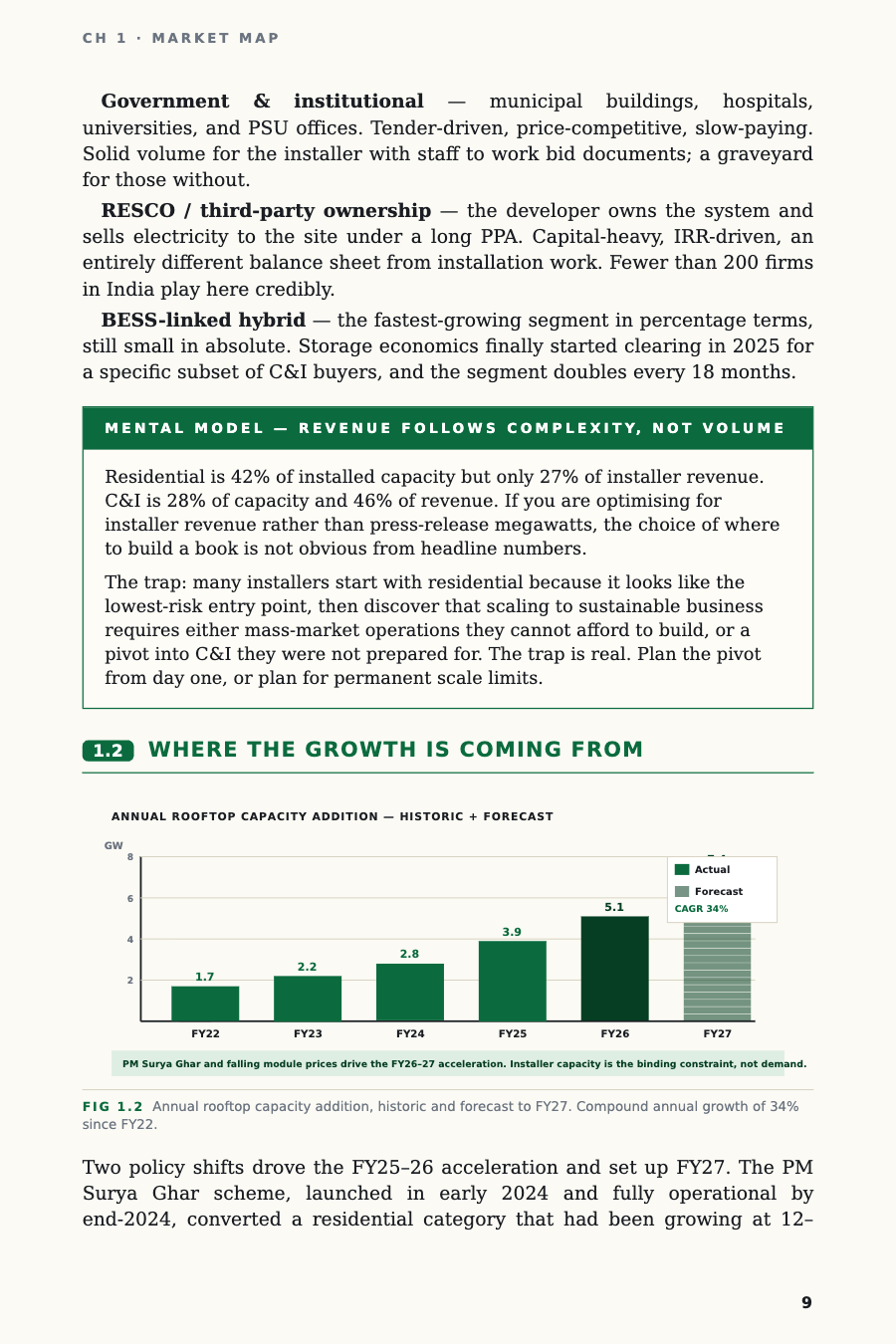
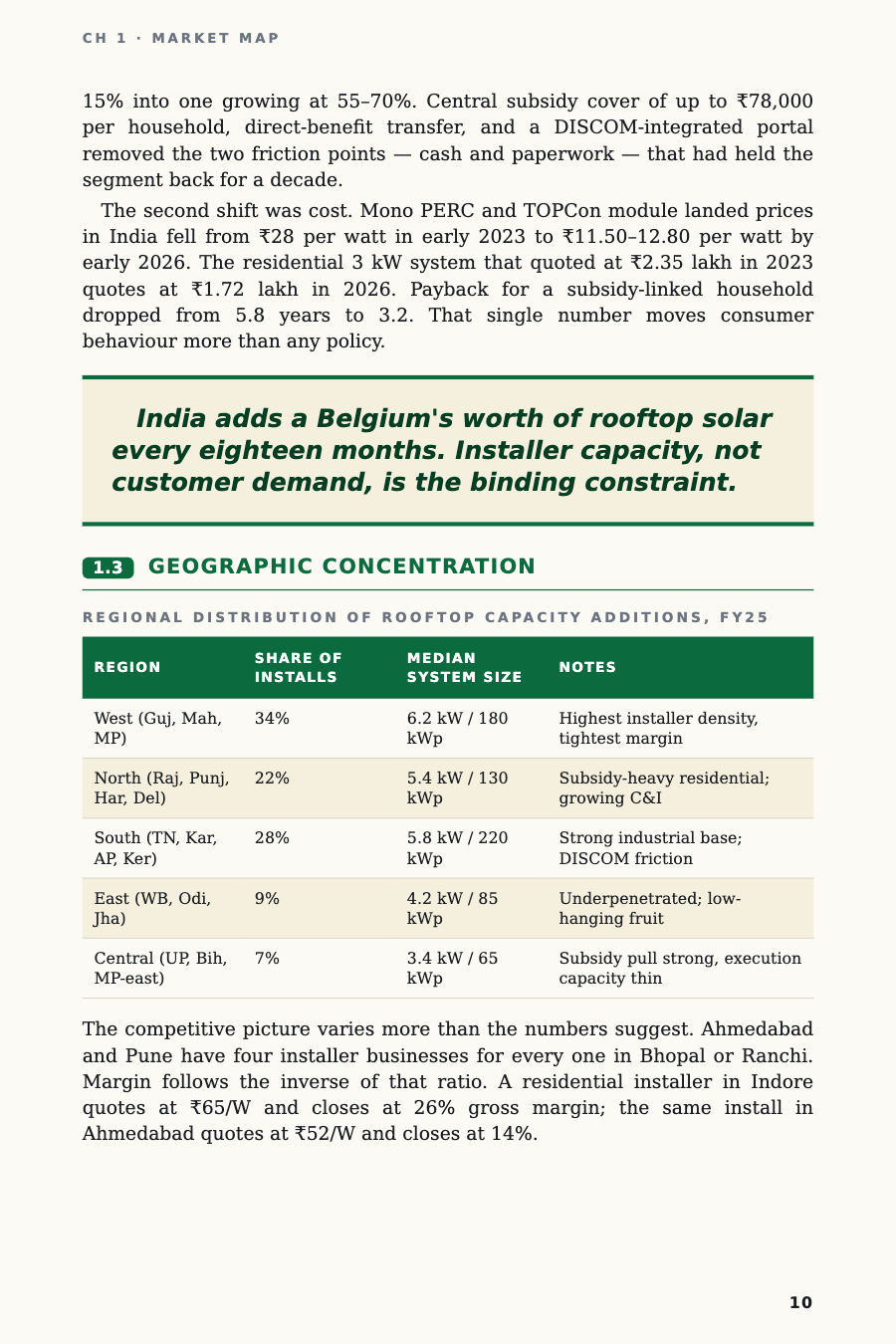


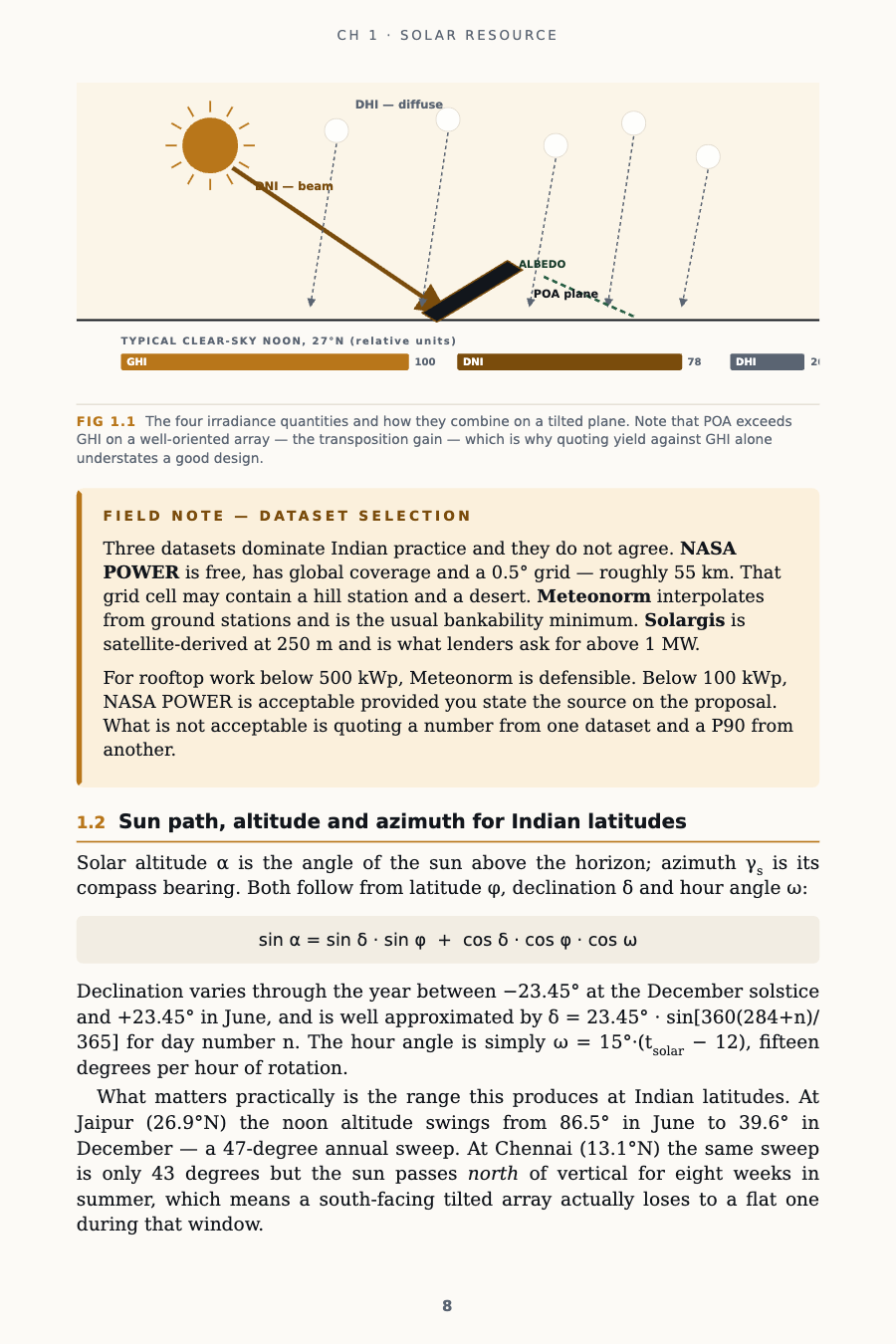
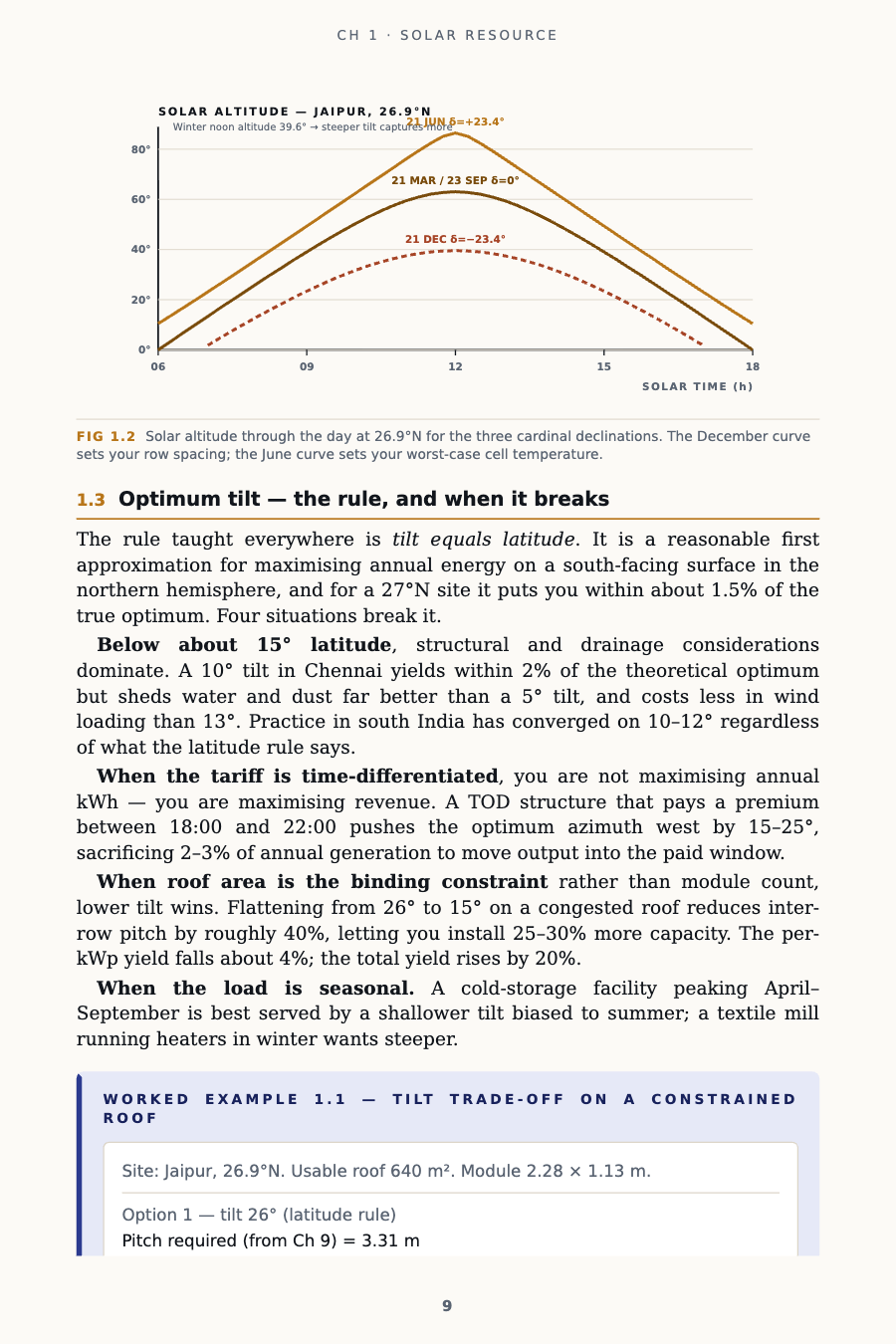

From engineers and installers running live projects
Design engineers, commissioning engineers, O&M teams and business owners.

The design calculations are what made this set worth it for me. Site survey, shadow analysis, string sizing, DC/AC ratio, cable sizing and voltage drop are explained as engineering decisions, not as theory. The PVsyst, yield estimation and BOQ sections gave my whole design workflow a proper structure.

Small mistakes during installation get very expensive later. This book covers mounting, cable routing, protection, earthing, lightning protection and commissioning in the right sequence. The pass/fail criteria and the commissioning checklist are what I actually keep open on site.

I used to treat design and maintenance as two separate things. This set connects them. You get monitoring, preventive maintenance and fault diagnosis alongside site survey and commissioning documentation. The troubleshooting matrix and the field notes make it a working reference rather than something you read once.

The Business Playbook was the more relevant half for me. Choosing a market segment, unit economics, costing, quotation, subsidy and customer ROI, right through to lead generation and B2B sales — all in one place. Procurement, project management, cash flow and AMC made me start looking at the installation work as a company, not a series of jobs.

Used together, the two books close the gap between the technical and the commercial side. One gives you site survey, system sizing, protection, commissioning and O&M; the other gives you pricing, sales, working capital, procurement and scale. For an installer that combination matters — building the system is only half of it, operating the business sustainably is the other half.
The design calculations are what made this set worth it for me. Site survey, shadow analysis, string sizing, DC/AC ratio, cable sizing and voltage drop are explained as engineering decisions, not as theory. The PVsyst, yield estimation and BOQ sections gave my whole design workflow a proper structure.
Small mistakes during installation get very expensive later. This book covers mounting, cable routing, protection, earthing, lightning protection and commissioning in the right sequence. The pass/fail criteria and the commissioning checklist are what I actually keep open on site.
I used to treat design and maintenance as two separate things. This set connects them. You get monitoring, preventive maintenance and fault diagnosis alongside site survey and commissioning documentation. The troubleshooting matrix and the field notes make it a working reference rather than something you read once.
The Business Playbook was the more relevant half for me. Choosing a market segment, unit economics, costing, quotation, subsidy and customer ROI, right through to lead generation and B2B sales — all in one place. Procurement, project management, cash flow and AMC made me start looking at the installation work as a company, not a series of jobs.
Used together, the two books close the gap between the technical and the commercial side. One gives you site survey, system sizing, protection, commissioning and O&M; the other gives you pricing, sales, working capital, procurement and scale. For an installer that combination matters — building the system is only half of it, operating the business sustainably is the other half.
Who this is for — and who it isn't
Written plainly, so the money goes to the right place.
Built for
- Solar design engineers who want the arithmetic, not the definitions
- Installation and commissioning engineers working on Indian rooftops
- O&M teams who have to find the fault, not just log it
- Founder-installers running or starting a solar company
- Electrical engineers and contractors adding solar to what they already do
Not for
- Complete beginners — it assumes you know what a PV cell is and can read a wiring diagram
- Anyone wanting an introduction to solar energy or exam preparation
- Anyone expecting legal, tax or financial advice — treat compliance content as orientation, not counsel
- Anyone who won't verify tariffs and subsidy slabs with their own DISCOM before quoting
Choose your format
Same content in both — 46 chapters across two volumes. The only question is whether you want it on the desk or on the phone.
Soft Copy (PDF)
- Both volumes — 46 chapters, 189 pages
- Lifetime online access, right after ordering
- Opens on mobile, tablet and laptop
- Search a formula or a slab while you're on the roof
Hard Copy — Both Volumes
- Both printed volumes — sit open on the design desk
- Soft copy free — lifetime online access the moment you order
- Works on site with no network and no battery
- Mark the page — write your own site values and slabs on it
- Free delivery all over India
Soft copy instantly, books delivered to your address.
Common questions
Which language are the books in?
English, written in working language rather than academic prose. Volume I also carries an English + Hindi glossary in Appendix G for the technical terms.
I'm new to solar. Will I be able to follow it?
This is not an introduction to solar energy. It assumes you already know what a photovoltaic cell is and can read a wiring diagram. Level is intermediate to advanced. If you have that base, Volume I builds the designer's judgement on top of it.
Are the compliance rules current?
They reflect the position at the start of 2026, including the ALMM List-I and List-II dual mandate that came into force on 1 June 2026. Tariffs, subsidy slabs, net-metering caps and empanelment rules differ by state and change without notice — every figure of that kind is marked with the date it was current. Verify against your own DISCOM before you commit it to a customer quotation.
Do I need both volumes, or just one?
Volume I answers how to build the system. Volume II answers where the customer comes from, what price wins the deal and how much cash you need to run five projects at once. If you only design, Volume I stands alone. If you run or want to run the business, the pair is the point.
Is the soft copy really free with the hard copy?
Yes. Order the hard copy and you get lifetime online access immediately — you don't wait for the books to arrive. No extra charge.
Can I use the financial figures directly?
Use the frameworks; verify the numbers. Rates, subsidy slabs, tax provisions and scheme parameters are subject to state variation and periodic revision. Nothing in the books is legal, financial or tax advice — a chartered accountant and a licensed electrical consultant are still cheaper than the mistake.