MECH FIELD MANUAL SET — VOL I + VOL II42 chapters · 12 partsGD&T · Stack-up · DFMAPQP · PFMEA · PPAP · 8D40 design-review questionsFree delivery all over India
M MASTERYBOOKS
FIELD MANUAL SERIES · MECH · VOL I + VOL II
2 VOL

Design · Manufacture · Qualify · Release Not the theory college gave you.
The chapters an employer asks about.

Two field manuals for mechanical engineers — 42 chapters, 225 pages. Every page carries a decision-asset: a selection matrix, a worked example, a checklist or a red-flag list. Prose is there to justify the decision, not to lecture.

42Chapters
12Parts
225Pages
40Review questions
⌀25 H7 / g6 Ra 1.6 18.0 ±0.2

Fits, stack-up, surface finish — the three things a drawing actually promises.

BOTH VOLUMES IN ONE SET
Design Engineer's Field Manual
VOL I · Design Engineer's Field Manual
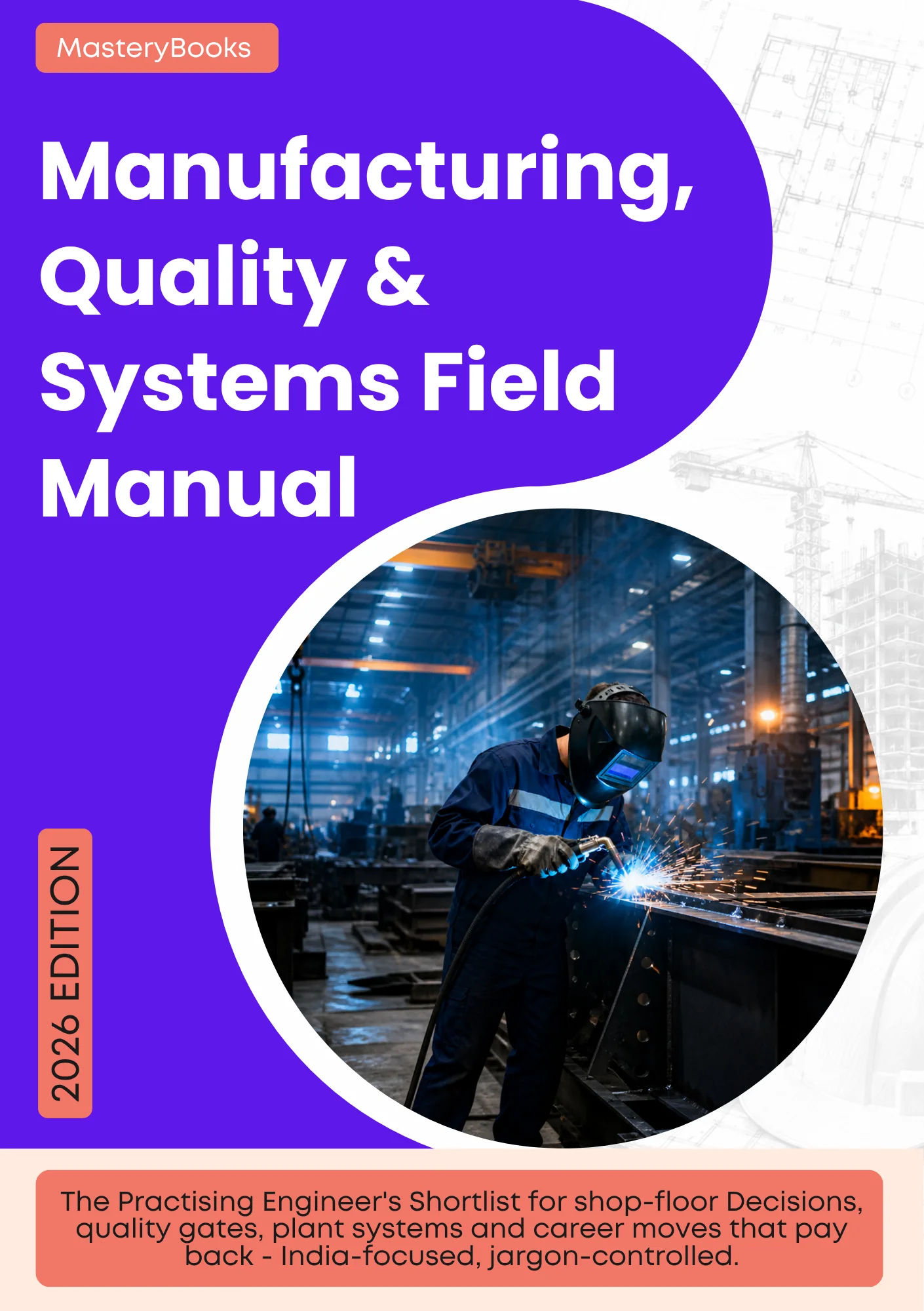
Manufacturing, Quality & Systems Field Manual
VOL II · Manufacturing & Quality
Intermediate to advanced — not a first textbook India-focused, jargon-controlled Decision tables, worked examples, printable checklists ASME Y14.5 · ISO 286 · IATF 16949 referenced A5 — sits open on the desk
06

Six moments where an engineer either has the answer or doesn't

A design review at 4 pm. A supplier call at 11. An interview on Saturday. Each of these has a chapter behind it.

STACK-UP

The parts assemble on the model and interfere on the bench, because nobody ran the stack. Vol I · Ch. 04 — Tolerance stack-up analysis, worst-case and RSS

GD&T

A feature control frame comes back from the supplier and the argument is lost in the meeting. Vol I · Ch. 03 — GD&T, the practitioner's core

FEA

The simulation looks convincing until someone asks about the mesh, the constraint and the load case. Vol I · Ch. 19 — FEA & CFD that survive review

PPAP

The submission is rejected and the launch date moves, over something avoidable. Vol II · Ch. 13 — PPAP, the 18 elements and why they get rejected

PFMEA

The failure mode is found on the shop floor instead of on paper — at ten times the cost. Vol II · Ch. 11–12 — PFMEA and the Control Plan

PROCESS

The part is designed for a process that was never the right one for that volume. Vol I Ch. 20 · Vol II Part 01 — DFM by process, machining to additive

Two failure modes cost mid-level engineers the promotion: drawing and tolerance at one end, DFM and release at the other. Vol I is built around fixing exactly those two — and Vol II picks it up the moment the design reaches the factory.

Volume I · The Core

A drawing is a contract. This is the clause everyone argues about.

Read a feature control frame correctly and half your supplier disputes end before they start. Chapters 1–4 build this from the drawing rules up to a full stack-up.

⌖⌀0.2 ⓂABC
⌖
CharacteristicWhat is being controlled — position, in this case.
⌀0.2
Tolerance zoneA cylindrical zone, not a square box. This alone changes the maths.
Ⓜ
Material conditionMMC — where bonus tolerance comes from, and where free assembly is won.
A B C
Datum reference frameThe order matters. Swap two datums and you have measured a different part.
Stack-up — stacked plates envelopeCH 04
Six plates, nominal 3.00 mm each18.00 mm
Slot nominal18.00 mm
Worst-case gap0.2 – 1.0 mm
RSS gap (statistical)0.38 – 0.82 mm
Worst-case says the joint always assembles. RSS says how it will actually behave in production. The book works all three stacks end to end — shaft-in-bore clearance, bolt clearance at MMC, and this one.
Volume II · The Flagship Part

The five gates every supplier engineer is measured against

Part 03 is the flagship of Volume II. Five chapters that structure a new part from concept to approved production — and the ceremony that decides whether your launch date holds.

APQP
5-phase frameworkStructures development so PPAP holds no surprises
PFMEA
Failure modes on paperFind them here, not on the shop floor
CONTROL
Control PlanThe shop-floor operating manual for quality
PPAP
18 elementsTurns an approved prototype into approved production
8D
Problem solving & CAPAEliminate causes instead of treating symptoms

Why PPAPs actually get rejected

  1. Ppk below 1.67 on a special characteristic
  2. GR&R above 30% on a critical measurement
  3. Ballooned drawing not at the latest customer revision
  4. Dimensional report signed by an unauthorised signatory
  5. Missing traceability from PFMEA row to Control Plan entry
  6. Sample parts from the wrong cavity or wrong tool
  7. Material certificate for the wrong specification
  8. Submission level not matching the customer's actual requirement

All eight are avoidable. Chapter 13 walks each one, in the order an auditor will find them.

PATHS

Read it once. Then keep it on your desk.

These are working manuals, not textbooks — so the books tell you where to start based on where you already are.

0–2 YEARSNew design engineer

Start with the drawing rules, GD&T, bolted joints, DFM and release — in that order. Leave the appendices until you've built something.

Ch 1, 3, 11, 13, 20, 21
3–7 YEARSMid-level engineer

Go straight to Part 1 and Part 6. These fix the two failure modes that cost mid-level engineers the promotion.

Part 1 + Part 6, then Vol II Part 03
INTERVIEWPreparing to switch

Read every core callout, then answer the 40 design-review questions in the appendix. That is the interview, in advance.

Core callouts + Appendix A5
VOL I + II

One volume gets the design out. The other gets it built and approved.

Volume I ends at release. Volume II begins where the drawing reaches the factory — process, metrology, quality gates, lean, maintenance and cost.

Volume I · Design

Design Engineer's Field Manual

Drawing, tolerance, sizing and release — for mechanical designers who ship hardware.

21Chapters
06Appendices
131Pages
  • PART 1Drawing & tolerance — drawing as a contract, fits & surface finish, GD&T, stack-up
  • PART 2Materials & failure — material selection, failure physics, corrosion, wear & surface treatment
  • PART 3Structural sizing — load path & safety factor, stress raisers, buckling, fatigue & durability
  • PART 4Machine elements — bolted joints, welded joints, bearings, shafts & gears, springs & seals
  • PART 5Thermal, fluid & dynamics — flow design, heat transfer, vibration & rotor dynamics
  • PART 6Simulation, DFM & release — FEA/CFD that survive review, DFM by process, DFMEA & change
  • A1–A6Formula card, standard sizes, achievable tolerance by process, conversions, 40 review questions, standards index
Volume II · Manufacturing

Manufacturing, Quality & Systems

Shop-floor decisions, quality gates, plant systems and the career moves that pay back.

21Chapters
06Parts
94Pages
  • PART 1Process engineering — machining, forming, casting, injection moulding, welding, additive
  • PART 2Metrology & statistics — verification, MSA, SPC & process capability
  • PART 3Quality system core — APQP, PFMEA, Control Plan, PPAP, 8D & CAPA
  • PART 4Lean operations — VSM & the 7 wastes, Kanban/TAKT/cell design, 5S, Kaizen, Poka-Yoke, SMED
  • PART 5Maintenance & reliability — TPM & OEE, RCM, PdM and PM strategy
  • PART 6Systems, cost & career — automation, PLC, robots & safety; costing, tools and the career map
  • APPXTemplates, standards index and glossary
Full contents

Open all 42 chapters before you decide

Nothing hidden. Both volumes, part by part.

VOL I Drawing, tolerance, materials & failure Ch 1–7
  • Drawing as a contract
  • Fits, limits & surface finish
  • GD&T — the practitioner's core
  • Tolerance stack-up analysis
  • Material selection as an engineering decision
  • Failure physics & reading a broken part
  • Corrosion, wear & surface treatment
VOL I Structural sizing & machine elements Ch 8–15
  • Load path, failure theories & safety factor
  • Stress raisers, buckling & stiffness budgets
  • Fatigue & durability
  • Bolted joints
  • Welded joints
  • Bearings & lubrication
  • Shafts, keys, gears & couplings
  • Springs, seals, guides & actuators
VOL I Thermal, simulation, DFM & release Ch 16–21 + A1–A6
  • Fluid systems & flow design
  • Heat transfer & thermal design
  • Vibration, rotor dynamics & noise
  • FEA & CFD that survive review
  • DFM & DFA by process
  • DFMEA, validation, release & change
  • A1 Formula quick-reference card · A2 Standard sizes — bolts, keys, bearings, sheet, sections
  • A3 Achievable tolerance & surface finish by process · A4 Unit conversion & constants
  • A5 40 design-review questions · A6 Standards index & glossary
VOL II Process engineering Ch 1–6
  • Machining processes — rate, finish and tool life as a negotiation
  • Forming — sheet & bulk
  • Casting & moulding
  • Injection moulding & plastics
  • Welding & fabrication
  • Additive & special processes — where it beats conventional
VOL II Metrology, MSA & statistical quality Ch 7–9
  • Metrology & verification — proving the promise on the drawing was kept
  • MSA — measurement system analysis
  • SPC & process capability
VOL II Quality system core — the flagship part Ch 10–14
  • APQP & the 5-phase framework
  • PFMEA
  • Control Plan
  • PPAP — the 18 elements
  • 8D problem solving & CAPA
VOL II Lean, maintenance, systems & career Ch 15–21 + appendices
  • VSM & the 7 wastes
  • Kanban, TAKT & cell design
  • 5S, Kaizen, Poka-Yoke & SMED
  • TPM & OEE
  • RCM, PdM & PM strategy
  • Automation — PLC, robots, safety
  • Cost, tools & career
  • Appendices — templates, standards index, glossary
Real pages

No mockups. This is what is inside.

Selection matrices, worked examples, checklists and red-flag lists — exactly as printed. Touch a page to pause.

Vol I · Design Engineer's Field Manual
Sample page
Worked stack-up example
Sample page
Selection matrix
Sample page
GD&T & tolerance tables
Sample page
Checklist & red flags
Worked stack-up example
Selection matrix
GD&T & tolerance tables
Checklist & red flags
Worked stack-up example
Selection matrix
GD&T & tolerance tables
Checklist & red flags
Vol II · Manufacturing, Quality & Systems
Sample page
PPAP submission levels
Sample page
Process comparison tables
Sample page
PFMEA & Control Plan
Sample page
Rejection reasons & red flags
PPAP submission levels
Process comparison tables
PFMEA & Control Plan
Rejection reasons & red flags
PPAP submission levels
Process comparison tables
PFMEA & Control Plan
Rejection reasons & red flags
5.0

From engineers using it in design reviews and audits

Design, process, quality, supplier quality and reliability engineers.

Aaryan Vohra
Aaryan VohraMechanical Design Engineer

This connected design theory to the decisions I actually make. GD&T, tolerance stack-up, fits and surface finish are the sections I keep going back to during design reviews. The worked examples and checklists are what make it usable — you apply the concept instead of just reading it.

Verified purchase
Zavian Rathore
Zavian RathoreProcess Engineer

The manufacturing sections are built for day-to-day work. Machining, tooling, cutting parameters and process selection are laid out so you can actually choose the right process. The tables comparing process, tolerance and surface finish are ones I refer to on the shop floor.

Verified purchase
Reyaan Mukherji
Reyaan MukherjiQuality & Metrology Engineer

The quality and measurement topics are explained the way they're used, not the way they're taught. The link between tolerances, inspection and actual manufacturing is the part that stayed with me — quality stops being final inspection and becomes a set of earlier process decisions.

Verified purchase
Kiaan Bendre
Kiaan BendreSupplier Quality Engineer

PFMEA, Control Plan, PPAP and 8D are what I deal with every week, so that part was directly relevant. What I liked is that it stays on the decisions an engineer has to make during an audit or a supplier discussion, rather than stopping at textbook definitions.

Verified purchase
Vireshan D'Souza
Vireshan D'SouzaManufacturing & Reliability Engineer

What makes this set worth it is that it covers what happens after a design reaches the factory. Process selection, quality checks, lean operations, maintenance and reliability — you get the wider view of manufacturing engineering. It works as a reference you keep nearby, not a book you read once and forget.

Verified purchase

Aaryan VohraMechanical Design Engineer

This connected design theory to the decisions I actually make. GD&T, tolerance stack-up, fits and surface finish are the sections I keep going back to during design reviews. The worked examples and checklists are what make it usable — you apply the concept instead of just reading it.

Verified purchase
Zavian RathoreProcess Engineer

The manufacturing sections are built for day-to-day work. Machining, tooling, cutting parameters and process selection are laid out so you can actually choose the right process. The tables comparing process, tolerance and surface finish are ones I refer to on the shop floor.

Verified purchase
Reyaan MukherjiQuality & Metrology Engineer

The quality and measurement topics are explained the way they're used, not the way they're taught. The link between tolerances, inspection and actual manufacturing is the part that stayed with me — quality stops being final inspection and becomes a set of earlier process decisions.

Verified purchase
Kiaan BendreSupplier Quality Engineer

PFMEA, Control Plan, PPAP and 8D are what I deal with every week, so that part was directly relevant. What I liked is that it stays on the decisions an engineer has to make during an audit or a supplier discussion, rather than stopping at textbook definitions.

Verified purchase
Vireshan D'SouzaManufacturing & Reliability Engineer

What makes this set worth it is that it covers what happens after a design reaches the factory. Process selection, quality checks, lean operations, maintenance and reliability — you get the wider view of manufacturing engineering. It works as a reference you keep nearby, not a book you read once and forget.

Verified purchase
FIT

Who this is for — and who it isn't

Written plainly, so the money goes to the right place.

Built for

  • Mechanical design engineers who release drawings and defend them in review
  • Process and production engineers choosing between machining, forming, casting and moulding
  • Quality, metrology and supplier-quality engineers living inside APQP and PPAP
  • Maintenance and reliability engineers running TPM, OEE and PM strategy
  • Engineers preparing to switch jobs — the 40 review questions are the interview, in advance

Not for

  • First-year students — the level is intermediate to advanced, not introductory
  • Anyone wanting derivations and proofs; the point here is the decision, not the lecture
  • Anyone expecting licensed standards — the books point to ASME, ISO and IATF, they don't replace them
  • Anyone who won't confirm numbers against their supplier's current catalogue before release
Both volumes, one set

Choose your format

Same content in both — 42 chapters across two manuals. The only question is whether you want it on the desk or on the phone.

Digital · instant

Soft Copy (PDF)

₹290₹99971% OFF
  • Both volumes — 42 chapters, 225 pages
  • Lifetime online access, right after ordering
  • Opens on mobile, tablet and laptop
  • Search a fit table or a PPAP element mid-meeting
Get Soft Copy — ₹290
MOST ORDERED
Printed set · delivered

Hard Copy — Both Volumes

₹899₹179950% OFF
  • Both printed manuals, A5 — sit open on the desk during a review
  • Soft copy free — lifetime online access the moment you order
  • Photocopy the checklists and keep them in your review folder
  • Mark the page — write your own values and supplier notes on it
  • Free delivery all over India

Soft copy instantly, books delivered to your address.

FAQ

Common questions

Which language are the manuals in?

English, written in working language and deliberately jargon-controlled. Both volumes carry a glossary in the appendices.

I'm a fresher. Will this help me?

The level is intermediate to advanced — it assumes basic mechanical engineering. That said, Volume I gives an explicit reading path for 0–2 years, and the 40 design-review questions in Appendix A5 are the fastest interview preparation in the book.

Do I need both volumes, or just one?

Volume I ends at design release. Volume II starts the moment the drawing reaches the factory — process, metrology, quality gates, lean, maintenance and cost. If you only design, Volume I stands alone. If your work touches suppliers, audits or the shop floor, the pair is the point.

Is this Indian industry focused?

Volume II is explicitly India-focused — shop-floor decisions, quality gates and plant systems as they run here, including the career map. Volume I is standards-based and applies anywhere, referencing ASME Y14.5, ISO 286, IS 800 and IATF 16949.

Is the soft copy really free with the hard copy?

Yes. Order the hard copy and you get lifetime online access immediately — you don't wait for the books to arrive. No extra charge.

Can I use the tables directly for release?

Every numerical table is computed from first principles and labelled as illustrative where relevant. They are correct as computed, but they are not a substitute for your supplier's current catalogue or your company's approved data sheets. Standards are living, licensed documents — always work from the current released version your company owns.

EDN 01

MASTERYBOOKS · FIELD MANUAL SERIES — First Edition, 2026

These manuals teach practice and refer to standards by number where relevant — ASME Y14.5, ISO 286, IS 800, IATF 16949 and others. Standards are living, licensed documents; the references here are pointers, not substitutes. Always work from the current released version your company owns, and confirm every number against your supplier's current catalogue or your company's approved data sheets before release.

© MasteryBooks. All rights reserved. No part of these publications may be reproduced, distributed or transmitted in any form without the prior written permission of the publisher.

Mech Field Manual Set — Vol I + Vol II42 chapters · 225 pages · 2 manuals
Scroll to Top